
Revolutionizing Healthcare: How AI Enhances Diagnostic Accuracy
Michael C.
AI in healthcare can sound scary until you see what it’s actually doing in hospitals: it’s not replacing doctors — it’s catching things humans miss when they’re tired, overloaded, or working with imperfect information.
When AI “enhances diagnostic accuracy,” the real benefit is simple: faster detection, fewer missed signals, and better decision support when the stakes are high.
What “diagnostic accuracy” means in real-world medicine
A diagnosis isn’t just a label. It’s a chain of decisions: symptoms → tests → interpretation → next steps.
Errors can happen anywhere in that chain — and that’s where AI tools can help by spotting patterns in data faster than any human team could.
Key insight
AI isn’t “more caring” or “more intelligent” than clinicians. It’s just extremely good at scanning large volumes of data and recognizing subtle patterns — especially in images.
Where is AI already improving diagnosis
If you want to know where AI is strongest right now, look at areas with clear, measurable data — especially imaging and pattern-heavy test results.
Here are the biggest use cases:
- Radiology (X-rays, CT scans, MRIs)
- Dermatology (skin lesion analysis via images)
- Pathology (microscope slide scanning)
- Cardiology (ECGs and rhythm patterns)
- Early risk detection using health records + lab results
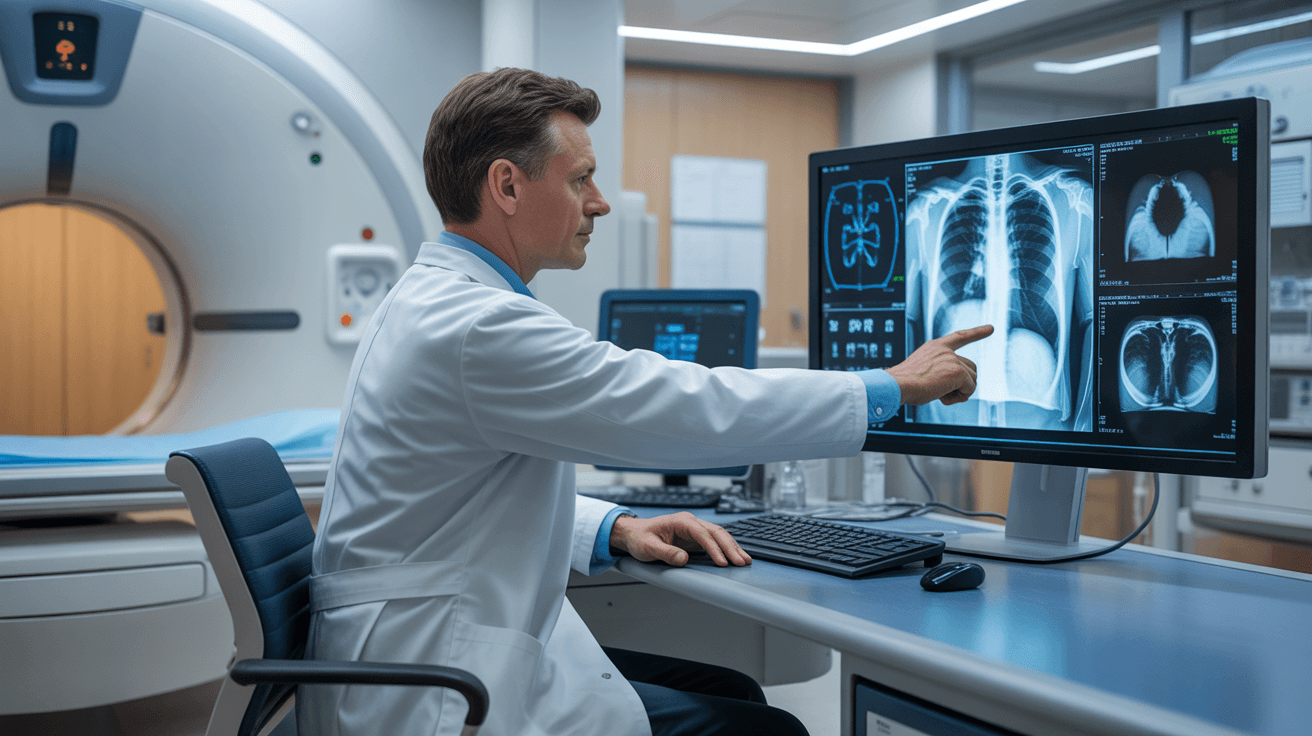
How AI boosts accuracy?
The best way to think of medical AI is decision support. It doesn’t make final calls (and shouldn’t). It helps clinicians prioritize and verify.
Here’s what that looks like day-to-day:
- Flagging abnormal scans so radiologists review urgent cases first
- Spotting small details that might be missed in fast workflows
- Reducing variation between different clinicians’ interpretations
- Cross-checking patterns across labs, notes, and history
The practical win
AI is most valuable when it helps clinicians move faster without cutting corners — especially in overloaded systems where time is the enemy.
The risks nobody should ignore
AI can improve outcomes, but it can also introduce new problems if hospitals treat it like magic instead of a tool that needs oversight.
The biggest risks include:
For a clear view of how health AI is being evaluated and regulated, the FDA’s AI/ML-enabled medical device overview is one of the best official references.
What patients should know (before trusting an AI tool)
As a patient, you might not even realize AI is involved in your care. But it’s still worth understanding what to ask.
Smart questions include:
- Was AI used as a decision support tool, or was this purely clinician judgment?
- Is this tool FDA-cleared (or regulated in my country) for this purpose?
- What follow-up testing confirms the result?
- How do you handle false positives and false negatives?
Bottom line
If an AI tool ever “diagnoses” you without a clinician involved, treat it as informational — not medical truth. Healthcare still needs accountability, context, and real human decision-making.
FAQ
How does AI improve diagnostic accuracy?
AI improves diagnostic accuracy by analyzing large datasets and images quickly, detecting subtle patterns, and helping clinicians prioritize and verify potential issues.
Does AI replace doctors in diagnosis?
No. AI tools are generally used to support clinicians, not replace them. Final decisions should still be made by trained healthcare professionals.
Where is AI most effective in healthcare today?
AI is especially strong in areas like radiology, pathology, dermatology imaging, and pattern-heavy test interpretation.
What are the risks of using AI in diagnosis?
Risks include bias in training data, false positives, false negatives, and over-reliance on automated systems without proper human oversight.
How can patients know if an AI tool is trustworthy?
Patients can ask whether the tool is regulated, whether a clinician reviewed the results, and what follow-up testing confirms the finding.
Key Takeaways
- AI boosts diagnostic accuracy by flagging patterns humans may miss.
- Imaging fields like radiology and pathology benefit the most right now.
- The best use of AI is decision support, not fully automated diagnosis.
- False positives and negatives still happen, so oversight is essential.
- Bias and data quality are major challenges in real-world health AI systems.
- Patients should treat AI results as guidance unless a clinician confirms them.
 Sport
Sport Super Bowl LIX: Kansas City Chiefs vs. Philadelphia Eagles - Full Match Preview
Posted on 2025-02-01
Written by: James P. Sports Reporter I cover sports the way fans actuall...
Uber Files Lawsuit Against DoorDash
Ride-share and food delivery giant **Uber** has filed a lawsuit against **DoorDash**, accusing its c...